

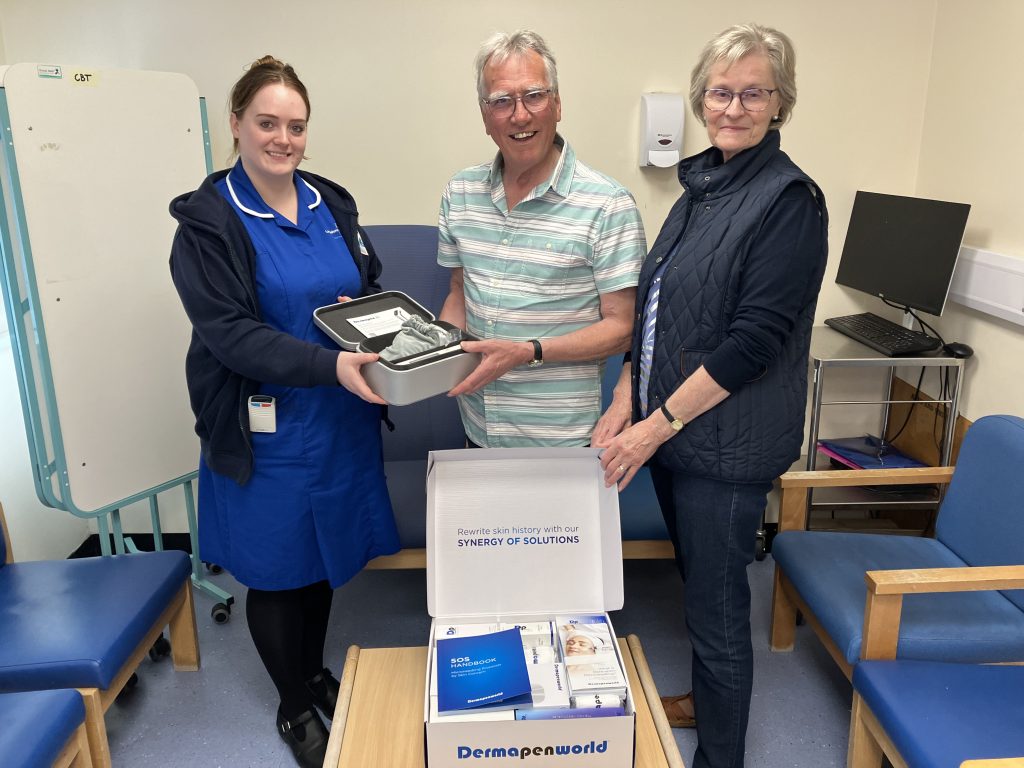
Burns patients being treated at the Royal Preston Hospital are now benefitting from a new micro-needling service, introduced to help heal scarring, after Lancashire Teaching Hospitals Charity spent £3,206 from its funds on a state-of-the-art Dermapen.
The Dermapen is fitted with ultra-fine sharp needles. The needles penetrate the skin to cause micro-injuries, which encourage the body to produce more collagen and elastin. When used on scarring, micro-needling can help to improve the texture and pliability of the scar, making it look smoother, feel less tight and in some cases, helping to return skin pigment (colour).
Lucy Clark, a fundraiser for Lancashire Teaching Hospitals Charity, explained: “Micro-needling is something people may know as an aesthetic treatment offered by some private cosmetic clinics for skin rejuvenation but it has a medical use as a scar treatment.
“Staff working on the Burns Unit have been keen to introduce micro-needling for some time but the equipment needed – the Dermapen – does not fall within the NHS’ funding remit, which is why we have had to buy one through charitable funds.”
Lucy added: “Having the Dermapen will make such a positive difference to many burns patients’ lives. Prior to its arrival, these patients – at least 120 a year – would have had to rely on just pressure garment therapy or they would have had to self-fund private micro-needling treatment. As anyone who has considered micro-needling as a beauty therapy will know, it is very expensive to the point of being beyond the affordability of many people.”
Among those to welcome the launch of the micro-needling service was former Burns Unit patient John Holmes and his wife Christine.
John, of St Michaels on Wyre, donated £36,302.42 to the Burns Unit last October after completing a two day sponsored walk from Silverdale to Garstang last May (2024) to commemorate the 40th anniversary of the 1984 Abbeystead Disaster, which claimed the lives of 16 people and left him and many others with serious burns.
John had been among 44 guests of the North West Water Authority, who had been taken to the valve house (pumping station) at Abbeystead to watch a demonstration of operations to alleviate flooding in St Michaels on Wyre. They were all inside the underground building when it blew up and filled with water. The explosion was later found to have been caused by a build-up of methane gas.